From Wikipedia, the free encyclopedia
MacRitchie Reservoir
The distinctive zig-zag bridge and Performing Arts Pavilion are popular spots at the reservoir
Coordinates 1°20′37″N 103°49′52″ECoordinates: 1°20′37″N 103°49′52″E
Lake type reservoir
Basin countries Singapore
MacRitchie Reservoir (Chinese: 麦里芝蓄水池, Pinyin: Maìlǐzhī Xùshuǐchí) is Singapore's oldest reservoir. The reservoir was completed in 1868 by impounding water from an earth embankment, and was then known as the Impounding Reservoir or Thomson Reservoir.
Contents
1 History
2 Present
3 References
4 See also
5 Gallery
6 External links
[edit]History
Boardwalk at MacRitchie Reservoir
Reservoir, boardwalk and running trail converge
Before the early 19th century, most of the Singapore main island was covered by primary forest. Soon after the British established a settlement in Singapore in 1819 and commercial activity took root, there was a demand for fresh water. However, it was decades before the settlement's first fresh water supply was established.
Between 1820 and 1870, a substantial portion of the virgin forest was cleared to assist Singapore in becoming an important trading post. Prior to this, Chinese planters had also worked the forested land for timber and the cultivation of crops like gambier, pepper and rubber. By 1886, only 10% of the original forest cover remained.
In 1823, British Resident John Crawfurd proposed the building of a reservoir and waterworks, setting aside $1,000 for these plans but nothing came of them. Another plan that ended up in smoke was the idea to tap the headwaters of Singapore Creek.
Finally, in 1857, Straits Chinese merchant Tan Kim Seng donated $13,000 for the improvement of the town's waterworks but delays, poor planning and use of the wrong building materials ate into the budget. New plans were drawn up for an impounding reservoir in Thomson. Tan's money was insufficient – the cost of the new reservoir was $100,000 – but colonial headquarters in Calcutta refused to make up the rest of the cost. When Tan died in 1864, the reservoir was no nearer completion.
Construction was eventually completed in 1868 but the pumps and distributing network were not finished until 1877. By this time, public confidence in the government's ability was dented.
In 1882, in a move to salvage its reputation, the Municipal Council erected a fountain in Fullerton Square in honour of Tan Kim Seng. The fountain was later to moved to Queen Elizabeth Walk, where it stands today.
In 1891, the holding capacity of the Impounding Reservoir or Thomson Reservoir, after its designer John Turnbull Thomson, was expanded to over 465 million gallons. Municipal Engineer James MacRitchie oversaw this $32,000 expansion and the reservoir was named after him in 1922. In the 1890s, he had urged the government to buy the Chasseriau Estate for use as a reservoir but it was not until much later that the purchase was made.
However, the reservoir's 4 million gallons a day were still insufficient to meet demand. Water was pumped into the reservoir from the upper section of Kallang River, one of the island's bigger sources of fresh water. Other fresh water supplies – Lower Peirce Reservoir and Seletar Reservoir – were completed in 1912 and 1920 respectively. However, the government realised that Singapore would not be able to meet its own fresh water needs. In 1927, a water treaty was signed with the Sultan of Johor. Singapore received its first supply of water from Johor in 1932 but Singapore is now more independent.
The development of the MacRitchie Reservoir brought the forest devastation around the area to a halt. The forest surrounding the reservoir has been protected as a water catchment reserve. The forested areas surrounding the other two reservoirs, Peirce Reservoir and Upper Seletar Reservoir (formerly Seletar Reservoir) were also protected when these reservoirs were developed.
During World War II, the Japanese Imperial Army during the Japanese Occupation of Singapore built a Shinto Shrine, Syonan Jinja,in the middle of the MacRitchie Reservoir forest in Singapore. When the British forces re-occupied Singapore, the Shrine was destroyed. However, ruins of the shrine remain and serve as a quaint piece of History accessible only to those willing to look for it, given its obscure location. The National Heritage Board declared the site a Historic Site in 2002, although no plans have been made public to develop or to protect the site.
[edit]Present
More than one square kilometre of primary forest still flourishes in the Central Catchment Nature Reserve today, particularly around MacRitchie Reservoir. Rubber trees, remnants of the plantations from the 19th century, can still be seen along the fringes around the reservoir.
There are boardwalks skirting the edge of the scenic MacRitchie Reservoir and walking trails through the forest. They range in distances from 3 km to 11 km. Interpretative signboards along the boardwalks allow for a self-guided tour along the fringes of the MacRitchie forest.
The boardwalk around the perimeter of the MacRitchie Reservoir brings the visitor through interesting secondary forest in the Central Catchment nature area. The boardwalk which hugs the reservoir also allows for easy exploration of freshwater wildlife. The Ant plant (Macaranga bancana.) and pitcher plants are common in the area.
In addition to the boardwalk, another popular attraction is the HSBC TreeTop Walk, a 250 m aerial free standing suspension bridge spanning Bukit Peirce and Bukit Kalang which are the two highest points in MacRitchie. The bridge was completed in July 2004, and the TreeTop Walk was officially launched on 5 November 2004. The structure, which is 25 m at its highest point, offers visitors a panoramic view of Upper Peirce Reservoir and the surrounding lush rainforest. Jelutong Tower also offers a view of the Singapore Island Country Club golf course and the MacRitchie Reservoir.
The 3.2 km and 4.8 km trails are still used as cross-country running routes for various inter-school competitions today.
Schools can be seen using the reservoir as a place for water sports such as canoeing and kayaking. There are certain competitions held there annually. A new amenities hub has been recently constructed following the opening of a multi storey car park. This is part of the renewal programme.
[edit]References
National Heritage Board (2002), Singapore's 100 Historic Places, Archipelago Press, ISBN 981-4068-23-3
[edit]See also
Syonan Jinja
[edit]Gallery
Wikimedia Commons has media related to: MacRitchie Reservoir
Sign to the treetop walk
The suspension bridge as part of the treetop walk
[edit]External links
National Parks Board, Central Catchment Nature Reserve - HSBC TreeTop Walk
360 interactive VR photo of MacRitchie Reservoir
SPI Investigates Syonan Jinja
v · d · eReservoirs in Singapore
Nature
Bedok · Jurong Lake · Kranji · Lower Peirce · Lower Seletar · MacRitchie · Marina · Murai · Pandan · Poyan · Pulau Tekong · Punggol · Sarimbun · Serangoon · Tengeh · Upper Peirce · Upper Seletar
Service
Changi Creek · Fort Canning · Jalan Eunos · Kallang · Murnane · Pearl's Hill · South End · Yishun
Planned
Categories: Reservoirs in Singapore | Parks in Singapore | Visitor attractions in Singapore | Central Water Catchment
Log in / create accountArticleDiscussionReadEditView history
Wednesday, August 24, 2011

Monday, August 22, 2011
Secret society in Singapore
Lim, Irene. (1999) Secret societies in Singapore, National Heritage Board, Singapore History Museum, Singapore ISBN 981-3018-79-8[verification needed]
[edit]See also
Salakau
Angsoontong
Ghee Hin Kong Si
Chung Keng Quee's and Tan Kim Ching's roles in the ending of the Larut Wars
Hai San Kong Si
List of Chinese criminal organizations
Tan Kim Ching
Triad (underground society)
[hide]v · d · eOrganized crime groups in Asia
National groups
Chinese Triad • Indian mafia • Japanese Yakuza • Kkangpae (South Korea) • Tamurats (Turkey)
View page ratings
Rate this page
What's this?
Trustworthy
Objective
Complete
Well-written
I am highly knowledgeable about this topic (optional)
Submit ratings
Categories: Secret societies in Singapore | Organized crime groups in Asia | Organisations based in Singapore | Gangs in Asia | Secret societies related to organized crime | Tongs (organizations) | Triad | Triad groups
Log in / create accountArticleDiscussionReadEditView history
[edit]See also
Salakau
Angsoontong
Ghee Hin Kong Si
Chung Keng Quee's and Tan Kim Ching's roles in the ending of the Larut Wars
Hai San Kong Si
List of Chinese criminal organizations
Tan Kim Ching
Triad (underground society)
[hide]v · d · eOrganized crime groups in Asia
National groups
Chinese Triad • Indian mafia • Japanese Yakuza • Kkangpae (South Korea) • Tamurats (Turkey)
View page ratings
Rate this page
What's this?
Trustworthy
Objective
Complete
Well-written
I am highly knowledgeable about this topic (optional)
Submit ratings
Categories: Secret societies in Singapore | Organized crime groups in Asia | Organisations based in Singapore | Gangs in Asia | Secret societies related to organized crime | Tongs (organizations) | Triad | Triad groups
Log in / create accountArticleDiscussionReadEditView history
Sunday, August 21, 2011
SINGAPORE POLICE FORCE HISTORY
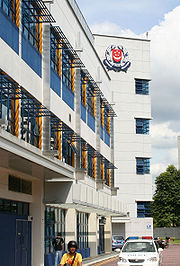

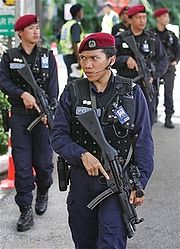
Singapore Police Force
Topic HomeDiscussion
Discussion
Ask a question about 'Singapore Police Force'
Start a new discussion about 'Singapore Police Force'
Answer questions from other users
Full Discussion Forum
Encyclopedia The Singapore Police Force (Abbreviation: SPF; ; ; ) is the main agency tasked with maintaining law and order in the city-state. Formerly known as the Republic of Singapore Police (Abbreviation: RSP; ), it has grown from an 11-man organisation to a 38,587 strong force. It enjoys a relatively positive public image, and is credited for helping to arrest Singapore's civic unrests and lawlessness in its early years, and maintaining the low crime rate today despite having a smaller police-citizen ratio compared to other major cities. Singapore has been ranked consistently in the top five positions in the Global Competitiveness Report in terms of its reliability of police services.
The organisation structure of the SPF is split between the staff and line functions, roughly modelled after the military. There are currently 15 staff departments and 13 line units. The headquarters is located in a block at New Phoenix Park in Novena, adjacent to a twin block occupied by the Ministry of Home Affairs.
History
Early years
The Singapore Police Force has a heritage almost as old as that of modern Singapore, having been formed in 1819 with a skeleton force of 11 men under the command of Francis James Bernard, son-in-law of William Farquhar, and kept in operation with a monthly budget of $300. Manpower constraints meant that the men had to perform a wide range of roles, and required the help of headmen amongst the various ethnic communities to maintain orderliness on the streets, all the more possible as the communities lived in segregated areas around the city.
This partnership with the community was in line with Sir Stamford Raffles' vision of a thriving colony largely self-regulated by local social structures, with the British masters administrating it via indirect rule. The large influx of migrants from China, however, began to test this system when the hands-off approach by the British allowed secret societies in Singapore to thrive. Although originally formed with legal intentions of community bonding and the provision of assistance to fellow migrants, these societies gradually became influential, competitive, and increasingly engaged in illegal activity including monetary extortion from the masses, the operation of gambling dens, and the smuggling of illegal goods on top of more legal commercial operations to meet their financial needs.
Competition gradually heated up between large rival factions, such as that between the larger Ghee Hin Kongsi, the Ghee Hock Kongsi and the Hai San Kongsi. Murders, mass riots, kidnappings, arson and other serious crimes became commonplace in the next four decades since the colony's founding. Faced with violent acts of crime which may involve thousands, such as the funeral riots of 1846 involving 9,000 members from the Ghee Hin and Ghee Hock secret societies, the police force was woefully incapable of bringing the situation under control, and often had to call in the army for assistance. The escalating number of serious crimes prompted the need for stronger legislation to deter would-be criminals. Singapore's first executions were thus held in the wake of the first criminal session in June 1828, when a Chinese and Indian were found guilty and convicted for murder.
Headed by Europeans and predominantly staffed by Malay and Indian officers, the force had little Chinese representation as the military and policing professionals were traditionally shunned by the Chinese community, which therefore impaired policing efforts amongst the large Chinese populace. In 1843, the force comprised a sitting magistrate doubling up as a superintendent, three European constables and an assistant native constable, 14 officers and 110 policemen. With a total strength of no more than 150 men, the police was compelled to avoid direct intervention in these mass acts of violence, else risking almost total annihilation.
A repeat of this scenario occurred in 1851, when lingering displeasure against Roman Catholic ethnic Chinese erupted into major rioting leaving over 500 Chinese dead. The army was called in again, although it involved having to induct Indian convicts into military service almost overnight. In 1854, twelve consecutive days of violence sparked by a dispute between the Hokkiens and Teochews disrupted trade. This particular incident led to the formation of the military's Singapore Rifle Corps on 8 July 1854, the earliest predecessor of the Singapore Armed Forces' People's Defence Force today.
Criminal violence was not merely in the domain of the ethnic Chinese, however. Rivalries between Malay princes and communities also often result in acts of violence, which prompted the passing of Singapore's first arms law in March 1823 restricting the right to bear arms to 24 of the Malay Sultan's followers. Nearly two centuries later, these anti-arms laws continue to be strictly enforced, resulting in a society relatively free from firearms-related criminal offences.
Police Pledge
We pledge to be loyal and true to the Police service and the Republic of Singapore.
We pledge to uphold the law, to protect life and property, to prevent and detect crime.
We pledge to discharge our responsibilities without fear or favour, regardless of race, language or religion.
We pledge to strive for excellence, to be proactive and to exercise initiative in our duties.
We pledge to serve our community and our country and to be courteous and humane in our dealings with every fellowman.
Police Headquarters
Appointment Rank Abbreviation Name Address
Commissioner of Police Commissioner of Police CP Ng Joo Hee New Phoenix Park, 28 Irrawaddy Road
Deputy Commissioner (Policy) Deputy Commissioner of Police DCP Wong Hong Kuan New Phoenix Park, 28 Irrawaddy Road
Chief of Staff Senior Assistant Commissioner SAC Vacant New Phoenix Park, 28 Irrawaddy Road
Senior Director (P&D) Senior Assistant Commissioner SAC Ang Hak Seng New Phoenix Park, 28 Irrawaddy Road
Staff departments
Department Abbreviation Director Address
Administration and Finance Department A&F SUPT Jo Choo New Phoenix Park, 28 Irrawaddy Road
Commercial Affairs Department CAD Mr. Ng Hian Sun Police Cantonment Complex, 391 New Bridge Road Block D
Criminal Investigation Department CID AC Hoong Wee Teck Police Cantonment Complex, 391 New Bridge Road Block C
Manpower Department MPD SAC Jerry See New Phoenix Park, 28 Irrawaddy Road
Operations Department OPS AC Lim Kok Thai New Phoenix Park, 28 Irrawaddy Road
Planning and Organisation Department P&O AC Ng Yeow Boon New Phoenix Park, 28 Irrawaddy Road
Police Custodial Department PCD AC Jarmal Singh New Phoenix Park, 28 Irrawaddy Road
Police Intelligence Department PID AC Hoong Wee Teck New Phoenix Park, 28 Irrawaddy Road
Police Logistics Department PLD DAC Stephen Teng New Phoenix Park, 28 Irrawaddy Road
Police National Service Department PNSD AC Tan Ngo Chew Old Police Academy, 1 Mount Pleasant Road Block 2A
Police Technology Department PTD MR Kan Siew Ning New Phoenix Park, 28 Irrawaddy Road
Public Affairs Department PAD AC Ng Guat Ting New Phoenix Park, 28 Irrawaddy Road
Security Industry Regulatory Department SIRD DAC Jessica Kwok New Phoenix Park, 28 Irrawaddy Road
Service Development and Inspectorate Department SDI AC Anselm Lopez New Phoenix Park, 28 Irrawaddy Road
Volunteer Special Constabulary VSC AC (V) S Lakshmanan Police Cantonment Complex, 391 New Bridge Road Block C
Traffic Police Department TP DAC Cheang Keng Keong 10 Ubi Avenue 3
Training Command TRACOM AC Zuraidah Abdullah Home Team Academy, 501 Old Choa Chu Kang Road
National Police Cadet Corps NPCC SUPT Rosalind Khoo Home Team Academy, 501 Old Choa Chu Kang Road
Line units
Line units Abbreviation Commander Address
Ang Mo Kio Police Division 'F' Division DAC Hsu Sin Yun 51 Ang Mo Kio Avenue 9
Bedok Police Division 'G' Division DAC Teo Chun Ching 30 Bedok North Road
Central Police Division 'A' Division DAC Tan Hung Hooi Police Cantonment Complex, 391 New Bridge Road Block A
Clementi Police Division 'D' Division DAC Melvin Yong 20 Clementi Avenue 5
Jurong Police Division 'J' Division DAC Florence Chua 2 Jurong West Avenue 5
Tanglin Police Division 'E' Division DACKoh Yak Leng 21 Kampong Java Road
Airport Police AP DAC Keok Tong San 35 Airport Boulevard
Gurkha Contingent GC DAC Ross Forman Mount Vernon Camp
Police Coast Guard PCG AC Teo Kian Teck 11 Brani Way
Public Transport Security Command TransCom DAC Andy Tan 132 Paya Lebar Road (Old Geylang Police Station, Geylang NPC)
Security Command SecCom DAC Lim Chee Pheng 2 Lorong 4 Toa Payoh (Old Toa Payoh Police Station)
Special Operations Command SOC AC Raymond Yeo Queensway Base
Finances
The Singapore Police Force receives the highest budget allocation annually compared to the various departments of the Ministry of Home Affairs (MHA), regularly accounting for about 50% ot its annual budget. For the financial year 2006 (for the year beginning 1 April 2006), S$2.27 billion was budgeted to the MHA, of which 52.8%, or S$1.28 billion was allocated for the Police Programme. Actual expenses in the 2006 financial year was S$1.33 billion, of which S$1.14 billion was spent on operating expenditure (against the budgeted S$1.10 billion) and S$188.28 million on development expenditure (budgeted at $171.52 million). Manpower costs amounting to S$709.11 million continue to dominate the SPF's expenditure, accounting for 62.2% of its operating expenditure and 53.4% of total expenditure in FY2006.
Year ended Operating Expenditure Development Expenditure Total Expenditure
Other Operating
(millions) Manpower
(millions) Total
(millions) Budgeted Total
(millions) Budgeted Total
(millions) Budgeted
31 March 2004 325.61 636.47 962.08 142.14 1,104.22
31 March 2005 325.27 655.56 980.83 214.83 1,195.66
31 March 2006 343.11 668.62 1011.73 948,615,140 267.74 246,085,700 1,279.47 1,194,700,840
31 March 2007 431.13 709.11 1,140.24 1,103,597,000 188.28 171,522,700 1,328.52 1,275,119,700
31 March 2008
1,218,736,370
69,353,000
1,288,089,370
31 March 2009
1,246,301,000
129,985,000
1,376,286,000
The latest budget for financial year 2008, S$1.38 billion was allocated to the Police Programme, or 47.2% of MHA's total budget of S$2.91 billion (The Ministry of Defence, in comparison, receives a S$10.08 billion budget allocation). This includes S$1.25 billion for Operating expenditure and $129.99 million for Development Expenditure. The main Development Expenditures expected in FY2008 included the installation of an electronic surveillance system, the building of an Integrated Tactical Training Centre and procurement of new Coastal Patrol Crafts for the Police Coast Guard.
Manpower
As at 31 March 2006, the total strength of the force stands at 34,397, of which 12,496 are full-time staff. Manpower trends in recent years are as follows:
Year ended Regulars Civilians PNSF PNSmen VSC Total
31 March 2003 7,791 1,210 3,664 21,843 1,020 35,528
31 March 2004 8,035 1,238 4,104 22,311 1,098 36,786
31 March 2005 8,001 1,255 3,958 23,461 1,164 37,839
31 March 2006 7,949 1,246 3,861 24,349 1,182 38,587
31 March 2007 7,826 1,206 3,464 20,852 1,049 34,397
The full-time uniformed officers are predominantly male, accounting for about 87% of total full-time strength. This is in part due to the all-male profile of PNSFs, although the ratio of female regular officers has been steadily increasing over the years. The force is also dominated by younger officers. Besides the presence of PNSFs who usually serve up to two years typically from age 18, there is also a relatively high turnover rate amongst regular officers.
Regulars
Regulars, or uniformed, full-time officers, constitute about 20% of the police's total workforce and number approximately 8,000 in strength. Basic entry requirements for police officers include normal fitness levels, good eyesight, and at least five passes in the GCE Ordinary level or a NITEC from the Institute of Technical Education, although those with lower qualifications may still be considered. Those joining the senior police officers require a basic degree from a recognised university. Alternatively, police officers from the junior ranks may also be considered for promotion into the senior ranks. Officers serving in the force as national servicemen are also regularly considered for absorption into the regular scheme. Basic training for all officers are conducted at the Home Team Academy, under the purview of the Police Training Command. It takes about six months and nine months to train a new police officer and senior police officer respectively.
As is the case with many other civil service positions in Singapore, the salaries of police officers are reviewed in accordance to market rates. Salaries are kept competitive as part of anti-corruption measures. Gross starting salaries for police officers may range from S$1,559.43 to $2,186.90, and that of senior police officers from S$2,650.00 to S$3,889.00, depending on entry qualifications and National Service.
Police officers commence their careers as Sergeants (Full GCE 'A' level or Diploma holders) or Corporals (other qualifications), while senior police officers start as either Assistant Superintendent of Police (2nd Upper Honours Degree and above) or Inspectors (2nd Lower Honours degree and lower). Reviews of an officer's performance for promotion consideration are conducted annually. Interviews conducted for promotion to certain ranks were phased out since 1995. It takes approximately five years for a police officer to be promoted to the next rank, although the system allows for accelerated promotion for outstanding officers.
While joining the force as a career is generally considered a respectable decision in contemporary Singapore, support from the ethnic Malay community has been traditionally stronger due to less social stigma attached to the profession. Traditionally, Chinese culture has eschewed careers in uniformed positions, resulting in a force dominated by non-Chinese officers for most of the force's early history. National servicemen also contribute a higher proportion of ethnic Malays in the force. The current ethnic profile of the force continues to have a significantly higher proportion of ethnic minorities compared to the national ethnic profile, although such an outcome is related to operational demands: police resources are typically deployed with a diverse ethnic mix to decrease communication problems while attending to incidents in ethnically-diverse Singapore.
Competition in the employment market, usually heating up during economic boom times, occasionally depressed the number of police recruits as well as its existing ranks. A series of major incidents in 2008 affecting agencies of the Home Affairs Ministry has led to the ministry conducting a study which concluded that there is a shortage of officers, resulting in officers being "overstretched, strained and overstressed". In the police force, it was admitted that the recruitment and retention of non-graduate police officers has been "adversely affected by the tighter labour market", with resignation rates increasing by 50% between 2004 and 2007. Recruitment figures, while remaining relatively stable, has been unable to "address the higher demands placed on the Force". Various measures were thus taken in response, including an increase in starting salaries, sign-on bonuses for senior police officers, and retention bonuses of up to S$30,000 for non-graduate police officers in a bid to encourage them to stay for at least eight years, over the five years where many leave at the end of their service bonds.
Police national servicemen
While national service was introduced in 1967 in Singapore, it was solely geared towards the building up of the Singapore Armed Forces. There was little urgency in the police force to increase its manpower strength until the Laju incident in 1974 demonstrated the need for additional trained reserve officers who can be called up at short notice in the event of an emergency. National service was thus extended to the Singapore Police Force in 1975, with the primary aim of guarding key installations and to act as a reserve unit. Subsequent expansion of the scheme, changing security needs, and the trend in outsourcing installation protection (such as to the Auxiliary Police Forces) has expanded their role to more functions, which may range from administration, investigation to front-line policing alongside their regular counterparts.
Volunteers
Formed in 1946, The Volunteer Special Constabulary (VSC) is an important component of the Singapore Police Force, contributing more than fifty years of volunteer service to the nation.
The VSC is composed of volunteers from all walks of life in Singapore, from businessmen to blue-collar executives to even bus captains, bonded with the same aspiration to serve the nation by complementing the Singapore Police Force. They are vested with equal powers of a police officer to enforce law and order in Singapore. VSC Officers don the same police uniform and patrol the streets, participate in anti-drug operations and sometimes even high-speed sea chases.
Previously headquartered at the Eu Tong Sen Street Police Station and Toa Payoh Police Station, it relocated to the new Police Cantonment Complex in year 2000.
Civilian staff
Civilian staff in the Police Force are deployed in areas such as technology, logistics, human resource and administrative and finance services as well as planning and intelligence.
The civilian staff schemes falls under the general civil service schemes managed by the Public Service Division. These schemes include:
Management Executive Scheme(MX) for degree holders
Home Affairs Senior Executive (HASE)
Corporate Support Scheme (CS) for diploma and below
Technical Support Officer
Corporate Support Officer
The civilization of non-core police functions have accelerated over the years in order to free up additional manpower for redeployment into Police Divisions. Other changes include the deployment of contract staff through organizations such as Ministry of Finance's VITAL.org for administrative staff and partners such as Singapore Technologies, CSA Singapore for technical support.
Staff Welfare
Aquatic Club
Home United Basketball Club (HUBC)
Home United Football Club (HUFC)
JOM - Clubhouse for Police Officers
Polwel Co-operative Society Limited
Police Computer Club
Police Sports Association (PSA)
Police Welfare Division
Senior Police Officers' Mess (SPOM)
Singapore Police Co-operative Society Limited
Uniforms
Dark blue (or more accurately Dacron blue) is the organisational colour of the Singapore Police Force, and has remained so continuously since 1969, although the first police uniforms introduced in 1856 were also in the same colour.
On 1 July 1969, dacron blue made a comeback to the uniform with a force-wide change away from khaki overnight, in part to coincide with Singapore's 150th anniversary since its founding in 1819. The new uniform comprises a dark blue peak cap, shirt, trousers, black belt, shoes and socks, and coded whistle lanyard in blue and white. 3 large and 4 small metal buttons, metal collar badges, and a metal cap badge are affixed, and a black plastic name tag completes the uniform. Metallic ranks, if any, are fixed to the sleeve or on the shoulders for senior officers. The lanyard was changed to a metal chain in 1972, and in 1985, the material of the uniform was changed from 75% polyester 25% cotton to 100% polyester for ease of daily maintenance.
Derivatives of the standard blue uniform (collectively called the no.3 uniform) was adopted for specialised forces and for all officers in various occasions which calls for more formal or casual attire. The Traffic Police Department was amongst the few to move away from the all-blue attire, adopting a short-sleeved white tunic, dark blue breeches, a black leather Sam Browne belt, and riding boots for its officers performing mobile squad duties. A white crash helmet is worn when on the move, while a new dark blue jockey cap with chequered white and dark blue patterns around its circumference is worn when convenient while performing static duty. Members of the Vigilante Corps are also attired by a white short-sleeved top similar in design to the dark blue version for normal officers, gold-coloured buttons and badges, and a dark blue beret in place of the peak cap.
Combat uniforms has also been adopted for specialist units such as those from the Special Operations Command and the Police Coast Guard (PCG), collectively known as the No.4 uniforms. These involve the replacement of metal buttons with sewn-on plastic ones, the avoidance of all other metallic accruements which are deemed potentially hazardous to the officer or to others and the use of long-sleeved shirts. SOC officers wear combat boots while officers in PCG use lace up leather shoes with non-slip soles. These units also tend to adopt the beret as their headgear, although PCG officers use the baseball cap while on operational duties.
There was no major change to the uniform since then, except for the adoption of embroidered shoulder ranks and badges for all ranks in the 1990s. Other changes are less distinct, such as the upgrading of shoes used, the change of the belt material and belt buckle to one including the police crest, and changes to the peak cap to a more durable and ventilated version.
Ranks
A standard rank structure is used throughout the police force, although some ranks may be unique to specific organisations. These ranks are denoted where applicable in the following list, which lists them in ascending seniority:
Police officers
The rank of Corporal was abolished in 1972, but reinstated in 1976. In 1997, all ranks were shifted from the sleeves to the epaulettes, except for the Gurkha Contingent. Also in the same year, the Station Inspector rank was changed from collar pips to epaulettes with a new design similar to that of the SAF Warrant Officers, and the rank of Senior Station Inspector was introduced. In 1998, the Senior Station Inspector (2) rank was introduced, and changes were made to the SI, SSI, and SSI(2) rank designs. The rank of Lance Corporal was abolished in 2002. The 2006, the Gurkha Contingent adopted embroidered ranks as part of an overhaul of its combat dress, but are worn on the right front pocket.http://www.webcitation.org/query?url=http://www.geocities.com/inescutcheon/RanksMilitary.htm&date=2009-10-26+00:26:41
Rank Abbreviation Trainee Regular NSF NSmen VSC Gurkha
Constable PC T/PC NA NA PC PC PC
Special Constable SC T/SC NA SC NA NA NA
Corporal CPL T/CPL CPL |SC/CPL CPL (NS) CPL (V) CPL
Sergeant SGT T/SGT SGT SC/SGT SGT (NS) SGT (V) SGT
Staff Sergeant SSGT NA SSGT SC/SSGT SSGT (NS) SSGT (V) SSGT
Senior Staff Sergeant SSSGT NA SSSGT NA SSSGT (NS) SSSGT (V) SSSGT
Station Inspector SI NA SI NA SI (NS) SI (V) SI
Senior Station Inspector SSI NA SSI NA SSI (NS) SSI (V) NA
Senior Station Inspector (2) SSI (2) NA SSI (2) NA SSI(2) (NS) SSI(2)(V) NA
Senior police officers
Rank Abbreviation Trainee Regular NSF NSmen VSC Gurkha
Inspector INSP OCT(NSF)
P/INSP INSP NSPI
NSI INSP (NS) INSP (V)
Chief Inspector NA NA NA NA NA NA C/INSP
Assistant Superintendent ASP P/ASP ASP ASP (NS) ASP (NS) ASP (V) ASP
Deputy Superintendent DSP NA DSP NA DSP (NS) DSP (V) DSP
Superintendent SUPT NA SUPT NA SUPT (NS) SUPT(V) SUPT
Deputy Assistant Commissioner DAC NA DAC NA NA DAC (V) DAC
Assistant Commissioner AC NA AC NA NA AC(V) AC
Senior Assistant Commissioner SAC NA SAC NA NA NA NA
Deputy Commissioner of Police DCP/DC NA DCP NA NA NA NA
Commissioner of Police CP NA CP NA NA NA NA
Weapons and equipment
Police officers in the various divisions are armed when conducting regular uniformed patrols and plainclothes duties. A force-wide change from the 5-shot Smith & Wesson Model 36 (with 3 inch barrel) to the 5-shot .38 Taurus Model 85 was undertaken in August 2002, featuring a laser sight and a new snatch-resistant holster. A new speedloader was introduced in the same year to replace the old bullet pouch, allowing for quicker reloading of the revolvers and reducing the likelihood of misplaced bullets. In 2001, the Monadnock PR-21 side handle baton (more commonly known as the T-baton) replaced the wooden batons and retractable nightsticks to enhance their defensive capabilities. In addition, each officer is issued with one pair of handcuffs.
The primary communication tool carried by each officer is through a digital radio set provided by Matra Nortel Communications, the same provider for other Home Team organisations such as the Singapore Civil Defence Force. A trial of individual palmtops (called mPOD), developed from the Hewlett-Packard Jornada 928, which allows officers to screen persons and vehicles on the go without having to rely on radio communication. There are currently no plans to roll out the mPOD forcewide as the results of the trial were not considered favourable.
Also currently on trial by officers from Bukit Merah East Neighbourhood Police Centre and Geylang Neighbourhood Police Centre is the Taser X26 stun gun, which provides another non-lethal means of subduing suspects. Despite some safety concerns due to incidents experienced by foreign police forces, the weapon was deemed suitable for use by trained personnel, and was rolled out in phases across other NPCs.
Strict enforcement of anti-arm laws which are in existence in Singapore since 1823 has resulted in a relatively disarmed society, where firearms-related crimes are rare. It is therefore not an operational requirement for police officers to don bulletproof vests when conducting normal policing duties. However, these vests are carried in police vehicles and stocked in police establishments and can be rapidly utilised should the situation require it. From 2004, new multi-purpose vests were introduced which offer officers protection against most handgun fire, knife thrusts, as well as doubling up as a buoyancy vest should officers fall into deep water.
In 2006, the Singapore Police Force acquired new firearms for the Special Operations Command, namely the Sphinx 3000 pistol. Prior to this, the standard issue for the SOC was the SIG P226 pistol, also operated by the Singapore Armed Forces Military Police Command. Heckler & Koch USP pistols are also known to be used by the Criminal Investigation Department, Special Tactics and Rescue (STAR), Security Command and the Police Coast Guard's Special Task Squadron. The Singapore Police Force, also uses the Heckler & Koch MP5 submachine gun and the Remington 870 shotgun.
Vehicles
Land division officers typically respond to calls in rapid-deployment vehicles known as the Fast Response Car (FRC). The SPF have been staunch users of Japanese-made saloon cars since the 1980s for patrol duties, with the mainstay models in use being the various generations of the Mitsubishi Lancers, Mazda 323s and Toyota Corollas. At the turn of the century they have also included Nissan Sunnys, and most recently acquired Subaru Impreza 1.6 TS sedans (not to be confused with the Subaru Impreza WRX used by the Traffic Police). All FRCs carry a large array of equipment to allow officers to conduct normal policing duties and basic investigative work which officers are expected to perform with the implementation of the Neighbourhood Police Centre (NPC) system. A typical FRC vehicle may therefore stock equipment for the force-opening of locked doors, conducting roadblocks, fingerprint collection, and the provision of first aid. On top of these, chemical agent protection equipment and bulletproof vests are also carried for the officer's protection.
In 2002, the Enhanced Patrol Vehicle Project was unveiled at the SPF's annual workplan seminar to highlight the need for off-road capability. The Volvo V70 AWD XC, Mitsubishi Space Wagon and Mitsubishi Chariot underwent evaluation in various NPCs. Eventually, all NPCs were to have at least three of such vehicles, but the project was met with skepticism by some of the public, stating that the police need not use such "luxurious vehicles" for police patrols. In 2004, the new Fast Response Vehicle (FRV) was introduced, consisting of cheaper modified Toyota Hi-Lux sport utility vehicles. These vehicles utilise diesel-power which provide greater ability to endure high usage on the roads over extensive periods of time. Their bigger storage space also allows for easier storage and retrieval of equipment.
Other vehicles typically used in NPCs include the scooters and vans. Bicycles, although currently less seen, are still used by land division officers occasionally, particularly when conducting routine patrols in large, sprawling private housing estates. At NDP 2007, the Singapore Police Force unveiled a Tenix S600 APC (Armored Personnel Carrier) had been purchased for its operations for the Special Operations Command.
For weaponry, equipment and vehicles of the various specialist forces, please see their respective pages for details.
Auxiliary Police Forces
Aetos Security Management Private Limited (CIAS / PSA / ST Kinetics)
Certis CISCO Security Private Limited - The oldest and largest auxiliary.
Singapore Airport Terminal Services (SATS) Auxiliary Police Force
Corporate Security and Revenue Scrutiny (CREUNCSE) Auxiliary Police Force
Units
Old Police Academy - vacated in 2006, relocated to Old Choa Chu Kang Road as part of the Home Team Academy, leaving behind the Police National Service provost unit and Traffic Police driving test school. The accommodation barracks and training facilities of the Old Police academy currently houses the training departments for all auxiliary police forces in Singapore.
Geylang Police Division defunct 'C' Division HQ - closed and vacated in 2000, areas of responsibility was divided between 'A', 'F' & 'G' Divisions. Station's status - Currently in use by Geylang NPC under 'G' Bedok Police Division and by Public Transport Security Command.
Toa Payoh Police Division defunct 'B' Division HQ - closed and vacated in 1988, areas of responsibility was divided between 'E' & 'F' Divisions. Station was refurbished and is currently in use by Security Command.
Land Divisions
Beach Road Police Station - former site of 'A' Division HQ, vacated in 2000 and was transferred to the charge of Singapore Land Authority (SLA), which in turn released the premises for use by private developers.
Eu Tong Sen Street Police Station - former HQ site of CAD, CID & VSC since 1994, vacated in 2001 and was transferred to the charge of SLA. Station status pending.
Joo Chiat Police Station - former site of 'G' Division HQ, vacated in 1987 and was transferred to the charge of SLA, which in turn released the premises for use by private developers.
Old Hill Street Police Station - vacated in 1980, this old police station and barracks was refurbished and rebuilt in 2001, it currently houses the Ministry of Information, Communications and the Arts of Singapore.
Paya Lebar Police Station - former site of 'F' Division HQ, vacated in 1987, released for use by 2nd Division HQ SCDF.
Queenstown Police Station - former site of 'D' Division HQ, vacated in 1988, released for use by 1st Division HQ SCDF.
Old Tanglin Police Station - former site of 'E' Division HQ, vacated in 2001, currently being redeveloped as the Interpol Global Complex.
Taman Jurong Police Station - vacated in 1980 and demolished in 1988, the surrounding land at the site has been redeveloped as a HDB housing precinct.
Ama Keng Police Sub-station sited directly across the road from Ama Keng Chinese Temple in Lim Chu Kang, the station was closed and vacated in 1980, duties taken over by Jurong Police Division.
Bukit Panjang Police Sub-station
Pasir Panjang Police Sub-station - closed and vacated in 1986 following the inauguration of Pasir Panjang NPP & West Coast NPP. Demolished in 1991, the surrounding land at site was redeveloped as a private condominium - The Spectrum.
Woodlands Police Sub-station - closed in 1999 (located within the old Woodlands Checkpoint building since 1980), Woodlands Neighbourhood Police Centre has since taken over its duty.
Kranji Police Post - closed and vacated in 1997 following the inauguration of Yew Tee NPP, building was demolished for land clearing to build factory.
Police Coast Guard
Kallang Regional Base - vacated in 2007, relocated to Brani Regional Base at Pulau Brani, status pending.
Jurong Regional Base - vacated in 1999, relocated to Gul Regional Base, base was demolished to make way for the Jurong Island Highway.
Pulau Sakeng Police Post - closed and vacated in 1987 after the last islander left, the island was subsumed by the land reclamation process of the nearby Pulau Semakau. The Semakau landfill receiving station was built on top of the island after the reclamation process.
Popular media works related to SPF
Books
In the service of the nation, 1985
999: True Cases from the CID, 1987
Service to the Nation: 50 years of the Volunteer Special Constabulary, 1998
Policing Singapore in the 19th & 20th centuries, 2002
Justice is Done, 2005
The Adventures of Constable Acai, 1987: A series of crime stories, based on actual crimes from police files were compiled into story books from the popular children's magazine Young Generation, about the adventures of a fictional policeman named Constable Acai. They were written by officers from the Crime Prevention Department to instill crime awareness in children during the 80's through to the mid 90's. The other books in this series are as below:
More Adventures of Constable Acai, 1989
Constable Acai Fights Crime, 1996
Novels
Operation Firestorm, 1997
Periodicals
Singapore Police Magazine
Police Life, 1971 to present
Police Life Annual
Television programs
Documentary
Crimewatch, 1986-Current
True Files, 2002–2007
Drama
Seletar Robbery (实里达大劫案), 1982
CID '83, 1983
First Step (踏上征途), 1986: On women in the police force
Patrol (铁警雄风), 1989: A take on the lives of the men in the Traffic Police Department
Crime and Passion (執法先鋒), 1991
Triple Nine, 1995-1998: On the adventures of a CID team.
City Cops (城市双雄), 1996
Of Cops And Men (警网双雄), 1996
Dare To Strike (扫冰者), 14 November 2000: the phrase "Dare to Strike" is the motto of the Central Narcotics Bureau
The Reunion (顶天立地), 26 December 2001
Heartlanders, 2002-2005: On two Neighbourhood Police Centre officers
True Heroes (城市英雄), 5 May 2003: On a rookie Neighbourhood Police Centre officer
The Frontline (家在前线), 2003: This fictional six-part TV show depicts how Singaporeans cope after the German mastermind of a neo-anarchist organisation sets off a bomb at a naval base as an anti-imperialistic statement against Singapore's ties with the United States. It showcases the capabilities of the Singapore Police Force and the Singapore Armed Forces to deal with terrorism. Many technologies introduced in this series has never been before shown to the public. It is also the only local television series to date to accurately depict the Police's elite Special Tactics and Rescue (STAR) team and the Army's Special Operations Forces (SOF) although the latter unit was never addressed by name in the show. They were instead referred to as "The Commandos".
Police & Thief, 2004–2010
Life Line, 2005–2007
Without Warning, 2006
C.I.D. (刑警2人组), 12 June 2006
Metamorphosis (破茧而出), 18 September 2007
Crime Busters x 2 (叮当神探), 30 September 2008
Unriddle (最火搭档), 2010
C.L.I.F. (警徽天职), 2011
Movies
The Last Blood (驚天十二小時), 1991
2000 AD (公元2000), 1999
After School (放学后), 2004: A film released by the National Crime Prevention Council to harness the power of cinema as a public education tool to reach out to young Singaporeans and their families.
See also
Project Griffin
Major crimes in Singapore
Law enforcement in Singapore
List of law enforcement agencies
Internal Security Department
Corrupt Practices Investigation Bureau
External links
Organization, Recruitment, and Training of Police
Public Order and Internal Security (1989)
Singapore Police Force Band
Training the Police
Police-related Singapore news
Crossing the generation gap
The source of this article is wikipedia, the free encyclopedia. The text of this article is licensed under the GFDL.
HISTORY OF THE SINGAPORE POLICE FORCE
From Wikipedia, the free encyclopedia
This article has multiple issues. Please help improve it or discuss these issues on the talk page.
It needs additional references or sources for verification. Tagged since December 2007.
It may contain original research or unverifiable claims. Tagged since December 2007.
Its tone or style may not reflect the formal tone used on Wikipedia. Tagged since December 2007.
It is written like a personal reflection or essay and may require cleanup. Tagged since December 2007.
The History of the Singapore Police Force is a long one, and in many ways, has paralleled the astronomical economic growth of the country the force is tasked to protect. From a staff of eleven men based in a simple attap hut, the force has grown to over 36,000 men and women, basing their operations from thirty-two Neighbourhood Police Centres, sixty Neighbourhood Police Posts, and various other land and marine establishments spread across the country.
[edit]Early years
The Singapore Police Force has a heritage almost as old as that of modern Singapore, having been formed in 1819 with a skeleton force of 11 men under the command of Francis James Bernard, son-in-law of William Farquhar. With no background nor knowledge on policing, Bernard had to work from scratch, as well as occasionally turning to Farquhar for help. In addition, he held multiple roles as magistrate, chief jailer, harbour master, marine storekeeper, as well as personal assistants to Farquhar.
Despite these constraints, Bernard managed to establish the force by recruiting a jemadar (Asian sergeant), eight peons (patrolmen), a jailer, and a Malay writer, kept in operation by a monthly budget of $300. It is likely that some of these men were recruited from amongst the Indian sepoys brought to the settlement by its founder, Sir Stamford Raffles. Manpower constraints meant that the men had to perform a wide range of roles, and required the help of headmen amongst the various ethnic communities to maintain orderliness on the streets, all the more possible as the communities lived in segregated areas around the city.
This partnership with the community was in line with Raffles's vision of a thriving colony largely self-regulated by local social structures, with the British masters administrating it via indirect rule. The large influx of migrants from China, however, began to test this system when the hands-off approach by the British allowed Secret societies in Singapore to thrive. Although originally formed with legal intentions of community bonding and the provision of assistance to fellow migrants, these societies gradually became influential, competitive, and increasingly engaged in illegal activities including monetary extortion from the masses, the operation of gambling dens, and the smuggling of illegal goods on top of more legal commercial operations to meet their financial needs.
Competition gradually heated up between large rival factions, such as that between the larger Ghee Hin Kongsi, the Ghee Hock Kongsi and the Han San Kongsi. Murders, mass riots, kidnappings, arson and other serious crimes became commonplace in the four decades after the colony's founding. Faced with violent acts of crime which may involve thousands, such as the Funeral riots in 1846 involving 9000 members from the Ghee Hin and Ghee Hock secret societies, the police force was woefully incapable of bringing the situation under control, and often had to call in the army for assistance. The escalating number of serious crimes prompted the need for stronger legislation to deter would-be criminals. Singapore's first executions were thus held in the wake of the first criminal session in June 1828, when a Chinese and Indian were found guilty and convicted for murder.
Headed by Europeans and predominantly staffed by Malay and Indian officers, the force had little Chinese representation as the military and policing professionals were traditionally shunned by the Chinese community, which therefore impaired policing efforts amongst the large Chinese populace. In 1843, the force consisted of a sitting magistrate doubling as a superintendent, three European constables and an assistant native constable, fourteen officers and 110 policemen. With a total strength of no more than 150 men, the force was compelled to avoid direct intervention in these mass acts of violence, or risk almost total annihilation.
A repeat of this scenario occurred in 1851, when lingering displeasure against Roman Catholic ethnic Chinese erupted into major rioting leaving over 500 Chinese dead. The army was called in again, although it involved having to induct Indian convicts into military service almost overnight. In 1854, twelve consecutive days of violence sparked by a dispute between the Hokkiens and Teochews disrupted trade. This particular incident led to the formation of the military's Singapore Rifle Corps on 8 July 1854, the earliest predecessor of the Singapore Armed Forces' People's Defence Force today.
Criminal violence was not merely in the domain of the ethnic Chinese, however. Rivalries between Malay princes and communities also often result in acts of violence, which prompted the passing of Singapore's first arms law in March 1823 restricting the right to bear arms to twenty-four of the Malay Sultan's followers. Nearly two centuries later, these anti-arms laws continue to be strictly enforced, resulting in a society relatively free from firearms-related criminal offences.
[edit]References
This article includes a list of references, related reading or external links, but its sources remain unclear because it lacks inline citations. Please improve this article by introducing more precise citations where appropriate. (December 2007)
"In the Service of the Nation", John Drysdale, Federal Publications, 1985 ISBN 9971-4-0703-5
"Phoenix: the story of the Home Team ", Felix Soh, Times Editions, 2003 ISBN 981-232-637-5
"Policing Singapore in the 19th & 20th centuries", Peer M. Akbur, Singapore Police Force, 2002 ISBN 981-04-7024-X
[hide]v · d · eSingapore Police Force
Awards and decorations · Establishments and installations · History · Uniforms
Headquarters
Ministry of Home Affairs · Commissioner of Police · Deputy Commissioner of Police
Departments
Administration and Finance · Commercial Affairs · Criminal Investigation · Manpower · Operations · Planning and Organisation · Police Custodial · Police Intelligence · Police Logistics · Police National Service · Police Technology · Public Affairs · Security Industry Regulatory · Service Development and Inspectorate · Volunteer Special Constabulary · Training Command
Line units
Airport Police Division · Ang Mo Kio Police Division · Bedok Police Division · Central Police Division · Clementi Police Division · Gurkha Contingent · Jurong Police Division · Police Coast Guard · Public Transport Security Command · Security Command · Special Operations Command (Crisis Negotiation Unit · Police K-9 Unit · Police National Service Full-time Light Strike Force · Police National Service Key Installation Protection Unit · Police Tactical Unit · Special Tactics and Rescue) · Tanglin Police Division · Traffic Police
Establishments
Home Team Academy · Mount Vernon Camp · Neighbourhood Police Centre · Neighbourhood Police Post · New Phoenix Park · Old Hill Street Police Station · Police Cantonment Complex · Queensway Base
Defunct
Old Police Academy · Geylang Police Division · Toa Payoh Police Division
Commercial and Industrial Security Corporation · Crimewatch · Fast Response Car · Fast Response Vehicle · National Police Cadet Corps · Police Life · Officers killed in the line of duty
View page ratings
Rate this page
What's this?
Trustworthy
Objective
Complete
Well-written
I am highly knowledgeable about this topic (optional)
Submit ratings
Categories: Singapore Police Force | History of Singapore | Law enforcement history
Log in / create accountArticleDiscussionReadEditView history
This article has multiple issues. Please help improve it or discuss these issues on the talk page.
It needs additional references or sources for verification. Tagged since December 2007.
It may contain original research or unverifiable claims. Tagged since December 2007.
Its tone or style may not reflect the formal tone used on Wikipedia. Tagged since December 2007.
It is written like a personal reflection or essay and may require cleanup. Tagged since December 2007.
The History of the Singapore Police Force is a long one, and in many ways, has paralleled the astronomical economic growth of the country the force is tasked to protect. From a staff of eleven men based in a simple attap hut, the force has grown to over 36,000 men and women, basing their operations from thirty-two Neighbourhood Police Centres, sixty Neighbourhood Police Posts, and various other land and marine establishments spread across the country.
[edit]Early years
The Singapore Police Force has a heritage almost as old as that of modern Singapore, having been formed in 1819 with a skeleton force of 11 men under the command of Francis James Bernard, son-in-law of William Farquhar. With no background nor knowledge on policing, Bernard had to work from scratch, as well as occasionally turning to Farquhar for help. In addition, he held multiple roles as magistrate, chief jailer, harbour master, marine storekeeper, as well as personal assistants to Farquhar.
Despite these constraints, Bernard managed to establish the force by recruiting a jemadar (Asian sergeant), eight peons (patrolmen), a jailer, and a Malay writer, kept in operation by a monthly budget of $300. It is likely that some of these men were recruited from amongst the Indian sepoys brought to the settlement by its founder, Sir Stamford Raffles. Manpower constraints meant that the men had to perform a wide range of roles, and required the help of headmen amongst the various ethnic communities to maintain orderliness on the streets, all the more possible as the communities lived in segregated areas around the city.
This partnership with the community was in line with Raffles's vision of a thriving colony largely self-regulated by local social structures, with the British masters administrating it via indirect rule. The large influx of migrants from China, however, began to test this system when the hands-off approach by the British allowed Secret societies in Singapore to thrive. Although originally formed with legal intentions of community bonding and the provision of assistance to fellow migrants, these societies gradually became influential, competitive, and increasingly engaged in illegal activities including monetary extortion from the masses, the operation of gambling dens, and the smuggling of illegal goods on top of more legal commercial operations to meet their financial needs.
Competition gradually heated up between large rival factions, such as that between the larger Ghee Hin Kongsi, the Ghee Hock Kongsi and the Han San Kongsi. Murders, mass riots, kidnappings, arson and other serious crimes became commonplace in the four decades after the colony's founding. Faced with violent acts of crime which may involve thousands, such as the Funeral riots in 1846 involving 9000 members from the Ghee Hin and Ghee Hock secret societies, the police force was woefully incapable of bringing the situation under control, and often had to call in the army for assistance. The escalating number of serious crimes prompted the need for stronger legislation to deter would-be criminals. Singapore's first executions were thus held in the wake of the first criminal session in June 1828, when a Chinese and Indian were found guilty and convicted for murder.
Headed by Europeans and predominantly staffed by Malay and Indian officers, the force had little Chinese representation as the military and policing professionals were traditionally shunned by the Chinese community, which therefore impaired policing efforts amongst the large Chinese populace. In 1843, the force consisted of a sitting magistrate doubling as a superintendent, three European constables and an assistant native constable, fourteen officers and 110 policemen. With a total strength of no more than 150 men, the force was compelled to avoid direct intervention in these mass acts of violence, or risk almost total annihilation.
A repeat of this scenario occurred in 1851, when lingering displeasure against Roman Catholic ethnic Chinese erupted into major rioting leaving over 500 Chinese dead. The army was called in again, although it involved having to induct Indian convicts into military service almost overnight. In 1854, twelve consecutive days of violence sparked by a dispute between the Hokkiens and Teochews disrupted trade. This particular incident led to the formation of the military's Singapore Rifle Corps on 8 July 1854, the earliest predecessor of the Singapore Armed Forces' People's Defence Force today.
Criminal violence was not merely in the domain of the ethnic Chinese, however. Rivalries between Malay princes and communities also often result in acts of violence, which prompted the passing of Singapore's first arms law in March 1823 restricting the right to bear arms to twenty-four of the Malay Sultan's followers. Nearly two centuries later, these anti-arms laws continue to be strictly enforced, resulting in a society relatively free from firearms-related criminal offences.
[edit]References
This article includes a list of references, related reading or external links, but its sources remain unclear because it lacks inline citations. Please improve this article by introducing more precise citations where appropriate. (December 2007)
"In the Service of the Nation", John Drysdale, Federal Publications, 1985 ISBN 9971-4-0703-5
"Phoenix: the story of the Home Team ", Felix Soh, Times Editions, 2003 ISBN 981-232-637-5
"Policing Singapore in the 19th & 20th centuries", Peer M. Akbur, Singapore Police Force, 2002 ISBN 981-04-7024-X
[hide]v · d · eSingapore Police Force
Awards and decorations · Establishments and installations · History · Uniforms
Headquarters
Ministry of Home Affairs · Commissioner of Police · Deputy Commissioner of Police
Departments
Administration and Finance · Commercial Affairs · Criminal Investigation · Manpower · Operations · Planning and Organisation · Police Custodial · Police Intelligence · Police Logistics · Police National Service · Police Technology · Public Affairs · Security Industry Regulatory · Service Development and Inspectorate · Volunteer Special Constabulary · Training Command
Line units
Airport Police Division · Ang Mo Kio Police Division · Bedok Police Division · Central Police Division · Clementi Police Division · Gurkha Contingent · Jurong Police Division · Police Coast Guard · Public Transport Security Command · Security Command · Special Operations Command (Crisis Negotiation Unit · Police K-9 Unit · Police National Service Full-time Light Strike Force · Police National Service Key Installation Protection Unit · Police Tactical Unit · Special Tactics and Rescue) · Tanglin Police Division · Traffic Police
Establishments
Home Team Academy · Mount Vernon Camp · Neighbourhood Police Centre · Neighbourhood Police Post · New Phoenix Park · Old Hill Street Police Station · Police Cantonment Complex · Queensway Base
Defunct
Old Police Academy · Geylang Police Division · Toa Payoh Police Division
Commercial and Industrial Security Corporation · Crimewatch · Fast Response Car · Fast Response Vehicle · National Police Cadet Corps · Police Life · Officers killed in the line of duty
View page ratings
Rate this page
What's this?
Trustworthy
Objective
Complete
Well-written
I am highly knowledgeable about this topic (optional)
Submit ratings
Categories: Singapore Police Force | History of Singapore | Law enforcement history
Log in / create accountArticleDiscussionReadEditView history
Toa Payoh Police Station
From Wikipedia, the free encyclopedia
(Redirected from Toa Payoh Police Division)
Coordinates: 01°20′23″N 103°51′0″E
The Toa Payoh Police Division (or 'B' Division, Chinese: 大巴窑警区, Malay: Divisyen Polis Toa Payoh) was a former police division of the Singapore Police Force, operating from 1977 to 1988.
Contents [hide]
1 History
2 See also
3 References
4 External links
[edit]History
First formed in 1950 as the Kandang Kerbau Police Station beside the old KK Hospital building (near the present day Land Transport Authority, Hampshire Office) at Kampong Java Road, it was moved to the new Toa Payoh Police Station in 1977[1] and was subsequently renamed 'B' Division, as part of the Singapore government's effort in providing every new town with a police presence[1].
Toa Payoh Police division was closed down in 1988, with its areas of control taken over by Tanglin Police Division ('E' Division) & Ang Mo Kio Police Division ('F' Division), respectively. The station became the Headquarters for the Police Volunteer Special Constabulary from 1988 until 1994, when Force Communications Branch of the Police Technology Department took over the use of the building. The building was vacated again in year 2000 for a major refurbishment before utilisation by the Police Security Command, which is a unit similar to the Hong Kong VIP Protection Unit.
[edit]See also
Toa Payoh ritual murders
[edit]References
^ a b "MHA Press Release". National Archive of Singapore.
[edit]External links
Adrian Lim Murders
[show]v · d · eSingapore Police Force
[show]v · d · eEstablishments and installations of the Singapore Police Force
This Singapore location article is a stub. You can help Wikipedia by expanding it.
This Singapore-related article is a stub. You can help Wikipedia by expanding it.
This law enforcement-related article is a stub. You can help Wikipedia by expanding it.
View page ratings
Rate this page
What's this?
Trustworthy
Objective
Complete
Well-written
I am highly knowledgeable about this topic (optional)
Submit ratings
Categories: Places in Singapore | Toa Payoh | Police divisions in Singapore | Police stations in Singapore | Singapore geography stubs | Singapore stubs | Law enforcement stubs
From Wikipedia, the free encyclopedia
(Redirected from Toa Payoh Police Division)
Coordinates: 01°20′23″N 103°51′0″E
The Toa Payoh Police Division (or 'B' Division, Chinese: 大巴窑警区, Malay: Divisyen Polis Toa Payoh) was a former police division of the Singapore Police Force, operating from 1977 to 1988.
Contents [hide]
1 History
2 See also
3 References
4 External links
[edit]History
First formed in 1950 as the Kandang Kerbau Police Station beside the old KK Hospital building (near the present day Land Transport Authority, Hampshire Office) at Kampong Java Road, it was moved to the new Toa Payoh Police Station in 1977[1] and was subsequently renamed 'B' Division, as part of the Singapore government's effort in providing every new town with a police presence[1].
Toa Payoh Police division was closed down in 1988, with its areas of control taken over by Tanglin Police Division ('E' Division) & Ang Mo Kio Police Division ('F' Division), respectively. The station became the Headquarters for the Police Volunteer Special Constabulary from 1988 until 1994, when Force Communications Branch of the Police Technology Department took over the use of the building. The building was vacated again in year 2000 for a major refurbishment before utilisation by the Police Security Command, which is a unit similar to the Hong Kong VIP Protection Unit.
[edit]See also
Toa Payoh ritual murders
[edit]References
^ a b "MHA Press Release". National Archive of Singapore.
[edit]External links
Adrian Lim Murders
[show]v · d · eSingapore Police Force
[show]v · d · eEstablishments and installations of the Singapore Police Force
This Singapore location article is a stub. You can help Wikipedia by expanding it.
This Singapore-related article is a stub. You can help Wikipedia by expanding it.
This law enforcement-related article is a stub. You can help Wikipedia by expanding it.
View page ratings
Rate this page
What's this?
Trustworthy
Objective
Complete
Well-written
I am highly knowledgeable about this topic (optional)
Submit ratings
Categories: Places in Singapore | Toa Payoh | Police divisions in Singapore | Police stations in Singapore | Singapore geography stubs | Singapore stubs | Law enforcement stubs
Friday, August 19, 2011
ETL 201 Selected History Topics for Primary Social Studies Essay
Oral History Report
(An Oral History Interview from a woman, Madam Low, who lived in Toa Payoh for fifty-four years and been through the development of Toa Payoh by Rachael Seah)
Introduction
Toa Payoh is one of the mature estates in Singapore. There was a vast stretch of swampy land dotted with fishponds and farms back in the 1920s. It was during 1964 where the Housing and Development Board (HDB) began its massive project on developing Toa Payoh into a planned satellite town. For this oral history report, I am fortunate to have an interview with Madam Low Kim Lam, in her early fifties, who have been living in Toa Payoh since 1949, when Toa Payoh was a still a swampy land with kampongs. Madam Low was the second eldest child in her family and she has five younger siblings. During her time living in kampong, her family sleep in a rented bedroom in an attap house. During the interview, Madam Low related her experiences, personal feelings and thoughts in a mixture of Mandarin and Teochew. She is very enthusiastic and very excited in sharing her information throughout the two-hours interview. Her accounts include her experiences about the life in kampong, feelings and things that she encountered after moving to a HDB flats and how she adapt to the change of environment.
Descriptions of the kampong
According to Madam Low, the Kampong that she used to stay was located at Lorong 8 and the name of the Kampong was called Puay Geng Teng. The houses that the villagers were living in were called the Attap houses at that time, which was made from wood and attap. When they needed water, they will retrieve it from a common public tap in the Kampong. They do not have any electricity supply back then what they used was those kerosene lamps to provide lights for them during the night, that why, according to Madam Low, the villagers usually be in house before dark because there was no lamp posts along the streets. It was until years later where the government started to install orange coloured street lamps along the roadside and, slowly, installation of water supply and electricity supply were made to individual houses and a meter was used to charge the usage. As for the public tap, it was then removed. There were also provision shops and kopi tiam in the kampong and lives were very simple back then.
According to the history record that I had found, there was indeed a kampong by the name of Puay Teng Keng meaning “ flying sky temple” located near the Lorong 8 industrial estate. It should be the kampong Madam Low was trying to refer to but she got the name wrong. In the record, it was stated that the kampongs in Toa Payoh was more or less self-contained, with about 100 households, provision shops… and medical halls with sinseh (a traditional Chinese doctor). It is also stated that there was standpipes for those villagers whose house did not have a well and quarrels were common scene that could be seen at the standpipes. There are a couple of points that was mentioned by Madam Low, which are different from the records that I had found. Example like, according to the Madam Low, there wasn’t any electricity in the kampong when she was young but according to the record, it is stated that electricity came from standing generators, water via standpipes, and it does not mentioned about anything using kerosene lamps.
Reasons for resettlement
According to Madam Low, there was a resettlement because the government wanted to develop the area to accommodate more residents. According to the history records, just like what Madam Low had mentioned, the development of Toa Payoh was done to give the growing population adequate shelter and to create better facilities for the residents as well as a better and convenience of transportation. In order to over come the acute shortage of proper housing, the HDB built a massive amount of flats to solve the problem despite on the quality used to built the flats, more focus are on the quantity and most of the flats are one or two-room flats. It was later after the problems have been solved; HDB started to build bigger flat like three-room flats and focus more on the quality of the workmanship.
Life in kampong and HDB flats
After the development of Toa Payoh, Madam Low and her family were offered a two-room rental apartment in Lorong 5 block 54 around 1967 or 1968. It was one of the few blocks that were built at that time. According to Madam Low, she said that staying in a HDB flat is more convenience compare to kampong in term of transportation and facilities, other than that, she still prefer to the kampong lifestyles because the air are fresher, the attap house are so cooling that they do not even need to but fan not to say air-condition and last but not least, she finds that when people are living in a kampong, they tend to be friendlier unlike the people who stay in a HDB flats where they always loves to compare the interior design of their house. She said that living in HDB is more competitive than living in kampong. She also mentioned about the arrival of Queen Elizabeth II to view the first 19th storey HDB flat in Singapore.
In the history record, Britain’s Queen Elizabeth II visited Toa Payoh on the 18 Feb 1972 with the Duke of Edinburgh and Princess Anne and made their way to the 19th-floor to see the view from the roof top. It is also stated that as a satellite town, Toa Payoh contains all the necessary facilities and services needed in the daily life of the residents, therefore, in terms of facilities and transportations, living in the developed Toa Payoh town holds the advantage. On the other hand, being a well-developed town, there are more vehicles and the apartments are more enclosed compare to the kampong where most people usually walk or cycle from one kampong to another and therefore, the air pollution is lesser and the ventilation in the attap house is better.
Madam Low’s final preference
Madam Low had mentioned that she misses the kind of life in kampong despite its inconveniency of transportations and facilities. She also stated that she finds that the people living in the neighbourhood are not friendly comparing to the past. According to the records, the government had provided social and recreational places and facilities as well as activities for the residents to get together to build up their relationships. The designs of corridors are also meant to promote interaction and allow the residents to visit each other more easily. Therefore, the reason that Madam Low had stated might came from her own perception of the neighbourhood.
In the last question of the interview, Madam Low had stated that she would continue to stay in Toa Payoh and is not willing to move to other estate as she felt that Toa Payoh is a very convenience place as it contains all the necessary facilities and services you can find in a new estate maybe even more. Other reasons for her are that she cherishes the memories she has in Toa Payoh and most of her friends are living in Toa Payoh. Her answer for her last question brought in the doubts about her pervious answer on unfriendly neighbours. I think what she meant by the “unfriendly neighbours” might be those people who are not in good terms with her, if not, why will she choose to stay in Toa Payoh because her friends are here.
Conclusion
After conducting this interview, I’ve realised that I’ve gained a lot of knowledge on the history of Toa Payoh. Although I used to stay in Toa Payoh for seventeen years, I’ve never know that Toa Payoh used to be a swampy kampong area. Although some of the information given by Madam Low are not found or proven in the history report, the personal testimony of Madam Low shed new light on how the lace looks like at that time and the advantages and disadvantages of the development. Oral history does provide a fresh insight to events in history where an insight to the human emotions of the times that past through the years and events are shown.
________________________________________________________________________
* I give permission for this work to be digitally stored and made available for NIE for education and research purpose.
References
• 2000, Housing & Development Board. Toa Payoh: Our Kind of neighbourhood. Published by Times Media Pte Ltd.
• Presented by A/P Ong Chit Chung. Toa Payoh Town: From Swamp land to Modern Living. Published: Singapore: Toa Payoh Town Council, [1994]
Websites
• http://www.ura.gov.sg/dgp_reports/toapayoh/int-hist.html
• http://www.mnd.gov.sg/newsroom/speeches/speeches_nd1998_300998.htm
Interviewer: Seah Yanlei, Rachael (S)
Interviewee: Mdm Low Kim Lam (L)
Place of birth: Singapore
Age: 54 year-old
Date of birth: January 1949
Dialect: Teochew
Duration of interview: 2 hours
Venue: Mdm Low’s house at Toa Payoh North
This interview was done in both languages, Mandarin and Teochew.
S: How long have you been staying in Toa Payoh?
L: I’ve been living there since I was born, since 1949. It been, let me see, around fifty over years from now. I used to stay in a kampong with my family then later moved to HDB flats in Lorong 5 and then moved to Toa Payoh North after I got married to my husband to stay with his family in 1972.
S: Could you describe how Toa Payoh looks like in the past, I mean how does the kampong, which you used to stay, looks like?
L: Well, it is dirty and we don’t have proper roads like today. Everyone was living in attap houses; it was made mostly using wood and attap. My parents rented a room from an auntie, just slightly bigger than the bedroom today, for $5 per month. My parents paid people to built a double storey platform for us to sleep and we slept on grass mats. My siblings and I, six of us, will squeeze at the top platform while my parents and two of my youngest sisters will occupied the bottom platform. There were provision shops, kopi tiam, and barber shops in my kampong. Swamp land could also be found near the kampong; Toa Payoh was full of swamp land at that time especially Lorong 8. We usually run around the kampong barefooted cause my parents could not afford to buy us shoes to wear, so when it rains, our foots would be cover with mud due to the muddy roads.
S: What is the name of the kampong you are staying?
L: Mmm.. I can’t remember much, it’s been so many years back but I think it should be called Puay Geng Teng or something. It used to be located at the industrial estate, you know, Lorong 8 there, somewhere near to the Toa Payoh Polyclinic. Just somewhere there lah. Life is really not easy at that time, you young people should consider very lucky. Do you know, the attap house I used to live always created problem for my family especially when it rains? The roof always leaking and we need to use the metal piece from the calendar to repair the roof. Living in the attap house is very cooling, we don’t need a fan at all, but it gets very noisy when it rain because of the impact of the raindrops onto the roof.
S: How is the security back then, is it as safe as now?
L: Safe, very safe. Much safer than now. I remembered when we are living in the kampong; people open their main door throughout the day even when they are sleeping. There’s no such things as thefts or any crimes. The gangsters in the kampong will protect us from strangers. Unlike now where there always a lot of crimes like break-in, molest, rape and so on. There’s no such thing back then. You tell me, who dares to open their main door nowadays and sleep comfortably? No right, although now we have law officers but people still feels insecure unlike in the past.
S: Are there water supply and electricity supply back then?
L: Well, we used to use kerosene lamps to provide us with lights and as for water, there’s a public tap where we will queue up for water, sometimes, we need to queue for almost two hours just to get a pail of water. It is only after a couple of years later where the government installed street lamps along the road, orange colour one and very far apart. By then, the government also installed water followed by electricity to individual houses and it was charged by meter, just like today. As for the public tap, it was then removed because every household have their own water supply. Before that, everyone will be in house before 8 p.m. cause it was very dark outside.
S: So life is very tough for you at that time?
L: Not really lah, I still enjoyed my childhood although life was poor at that time. My parents sent me to a Primary school but I stopped studying at Primary Two because my parents could not afford to allow me to continue to study because of my younger siblings. So I stayed at home and help my mother to earn some money by printing those kim zhua (paper money for the dead) using a specific chop and red ink. After that, when I was around twelve years old, I went to work in a provision in another kampong, can’t remember the name, but it near to today Toa Payoh Swimming Complex. It is the same provision shop where my father worked as a deliveryman. I remembered that I earned around $1.60 per day, it’s considered quite a lot for me and I get my salary every two weeks but was all given to my mother but sometimes she will give me twenty-five cents to let treat myself with a bowl of wanton noodles.
S: You said earlier that you and your family moved to live in HDB when you are around fifteen or sixteen years old, what happened then, I mean do you know why you are moving to the HDB flats?
L: Not very sure, but I think it is the government who wants us moved. I heard from my parents that the government wanted to develop the place so that more people can live in Toa Payoh. During that time I’m still young, only know that earning money comes first, never bother about this kind of stuff so when my parents moved I just tag along with them but I heard there are a couple of people in my kampong complaint and not willing to move because they have job stabilised and they like the kind of living they are in. These are usually the farmers and provision shop owners, you know, who are afraid to lose all their hard earned money and properties.
S: Did the government compensate the people in the kampong, including your family, for resettlement?
L: As the room we stayed was rented, we didn’t receive any money at all and as for the rest, I’m not sure.
S: Ok, so when and where are you moved to then?
L: We were offered a two-room rental flat in Lorong 5, block 54 during late 1960s, I think it around 1967 or 1968. I remembered there’s one years when some well-know queen from don’t know which countries came and a lot of people went to see. It is very crowded, noisy and like very grand. They came to view the first 19th storey HDB flat in Singapore, block 53.
S: Do you prefer the kampong lifestyles or HDB lifestyles?
L: Well, comparing living in HDB and living in kampong is of course very different. Living in HDB, the transportations are better, more convenience. You can easily get a bus from the bus stop downstairs while in kampong, we need to walk around twenty to thirty minutes to take a bus or we need to take trishaw and it cost around thirty to fifty cents at that time. Even going to the market is more convenience when you live in HDB. So comparing the two, living in HDB is more convenience than living in kampong. But one thing bad about living in HDB is that the condition of the air we breathe, it is more polluted and HDB flats are stuffier. Unlike in the kampong where the air is very fresh and the attap houses are cooling and more ventilation. Overall I still prefer living in kampong because there’s more freedom, the neighbours are friendlier comparing to the neighbours now is just that the transportations were very inconvenience that’s all.
S: Do you encounter any pressure or differences after you moved to HDB flat?
L: Yes, you know, life in kampong is very simple and easy, every houses looks alike. But in HDB flats, people tend to compare the interior design of your house to judge your statues and look down on your family. So life is quite different in that sense more competitive.
S: So did you able to find yourself a job after moving?
L: Yes, I worked as a sewer after that and I continue after I married to my husband in 1972. I moved to block 203 at Toa Payoh North after the marriage to stay with my in-laws. After my in-laws die, my husband take over the house till now.
S: After living in Toa Payoh for so many years, would you like to say something about Toa Payoh? I mean how the upgrading of the flats and facilities has helped you in certain way, why you remain staying in Toa Payoh all this years?
L: Well, as you can see, Toa Payoh have been develop into a convenience places where you can get almost everything within Toa Payoh itself, there’s no need to travel all the way to city area to buy stuff. As I’ve been staying here for so many years and been through the changes of Toa Payoh, I find it memorable for me to stay here for the rest of my life. Furthermore, most of my friends lived here and getting to move to another estate is to ask me to start all over again and I don’t think I want to do that.
Done by : Seah Yanlei, Rachael (020329K24)
Page of 8

From Wikipedia, the free encyclopedia
Toa Payoh
English Toa Payoh
Chinese 大巴窑
(Pinyin Dàbāyáo)
Malay Toa Payoh
Tamil தோ பயோ
Toa Payoh New Town
Total area: 4.63 km²
Residential area: 2.10 km²
Dwelling units: 35,119
Projected ultimate: 48,000
Population: 116,800
Toa Payoh (simplified Chinese: 大巴窑; traditional Chinese: 大巴窯) is a district located in the Central Region of Singapore. It commonly refers to the Housing and Development Board (HDB) housing estate of Toa Payoh New Town, one of the earliest satellite public housing estates in Singapore.
The Toa Payoh Planning Area, an urban planning zone under the Urban Redevelopment Authority, encompasses the Toa Payoh New Town, Potong Pasir and the private housing estates in the Upper Aljunied area. The planning area is bounded by Braddell Road and Bartley Road to the north, Upper Paya Lebar Road to the east, MacPherson Road and Jalan Toa Payoh to the south and Thomson Road to the west. It covers a total of 845 ha in land area.
Toa Payoh Stadium and Sports Hall.
Contents [hide]
1 Etymology
2 History
3 Toa Payoh New Town
3.1 Toa Payoh Town Centre
3.2 Toa Payoh Town Park
4 Sports and recreation
5 Politics
6 Famous residents
7 TV shows about Toa Payoh
8 External links
9 References
[edit]Etymology
Toa Payoh is a Hokkien language reference to "big swamp" (toa is "big" and payoh means "swamp"). The Malay word for swamp is paya. The reference indicates the large swampy area that preceded the later development of Chinese market gardens in this area.
It is the Chinese equivalent of Paya Lebar, that is, big swamp land. To older generation Chinese, Toa Payoh is known as ang change shan (or anxiangshan) or "burial hill" because of the cemetery located in the area.
J.T. Thomson, a government surveyor, refers to Toa Payoh in his 1849 agricultural report as Toah Pyoh Lye and Toah Pyoh. Whampoa or Hoo Ah Kay had an orange garden here that Johnson visited. The neglected garden which Whampoa had bought was converted into a tasteful "bel-retiro" with its avenues, front-orchard, hanging gardens, Dutch walls, bamboos and orange trees, shrubs, stags and peafowls, its aviary and menagerie and artificial curiosities of horticulture.
[edit]History
Toa Payoh was once an extensive and notorious squatter district. Most squatters were engaged in farming and rearing pigs. The others were hawkers, factory workers, mechanics or domestic helpers.
The squatters started moving out in 1962 as a result of increased compensation rates and other practical inducements offered by the Government. Clearance work was able to commence and the redevelopment started in early 1964.
Queen Elizabeth II visited the area in the years 1972 and 2006.
[edit]Toa Payoh New Town
An apartment block in Toa Payoh New Town at Toa Payoh Lorong 6. The HDB Hub and point blocks at Toa Payoh Town Centre can be seen in the background.
Toa Payoh Town Centre
The Toa Payoh New Town, HDB's second satellite town, was built in 1968. The layout of the new town follows urban planning principles of the time. The housing estate is self-contained and has a town centre acting as a focal point for the shopping and entertainment needs of the residents.
Industrial developments were also built within the town to provide residents with job opportunities close to home while schools were built within the neighbourhoods.
[edit]Toa Payoh Town Centre
The town centre was the first prototype in Singapore. It is surrounded by separated neighbourhoods, each with its own shopping amenities and community centres, well served by a network of vehicular roads and generous open space separating them. The result, as in the English new towns of the 1950s, is that residents tend less to travel to the main town centre but rather to shop within their neighbourhood; if they travel, they go to Orchard Road or the town area via the MRT system, at the Toa Payoh MRT Station and the Braddell MRT Station, or public bus services at Toa Payoh Bus Interchange.
Nevertheless, with time, the Toa Payoh Town Centre has become increasingly popular. It has a busy atmosphere because, as with many shopping malls of the time, all commercial activities are concentrated along a single mall with high point blocks on either side and major department stores at each end. The shopping mall is actually L-shaped and there are two plazas, one with a branch library and cinema, the other with an area office and a post office. Each plaza has a department store at either end.
The commercial development, HDB Hub, located at the Toa Payoh Town Centre was completed in 2002. The Housing and Development Board relocated its headquarters from its premises at Bukit Merah to the HDB Hub on 10 June 2002. The HDB Hub comprises two wings, an atrium, four commercial building blocks, a leisure and learning centre and a three-storey basement parking lot. The building also accommodates Singapore's first fully air-conditioned Toa Payoh Bus Interchange and integrates it with the existing Toa Payoh MRT Station.
Another landmark of Toa Payoh is the facility of Royal Philips Electronics (the Dutch multinational making medical and electronics equipment). Philips established an extensive facility, parts of which are now owned by Jabil and NXP. The facility has been used by Philips for developing, amongst others, televisions and DVD players for years.
[edit]Toa Payoh Town Park
The distinctive viewing tower at Toa Payoh Town Park to the right, with the tower block of HDB Hub in the background.
The Housing and Development Board decided to allocate a large area of the Toa Payoh New Town for a garden-landscaped park, the Toa Payoh Town Garden, despite the pressure on land here for housing.
The town garden used to be popular with visitors who came from near and far to enjoy the display of willows, bamboos and the brilliant reds and yellows of the Delonix regia trees. At the heart of the garden is a 0.8 ha carp pond which contains a waterfall and a cluster of islands linked by bridges. The islands are arranged to provide a sequence of delightful walking experiences not only by day but also by night when the garden is lit. The garden is buffered from the noise and night-time glare of passing traffic along Jalan Toa Payoh by an elevated slope planted with thick rows of Angsanas. There are also a children's playground, seating areas and outdoor chessboard, a tea kiosk and a 27-metre high viewing tower.
Toa Payoh Town Garden was partially closed in 1999 to make way for a temporary bus interchange. After the new Toa Payoh Bus Interchange at the HDB Hub was completed in June 2002, the temporary bus interchange was converted to a landscaped park. Toa Payoh Town Garden was subsequently renamed as Toa Payoh Town Park.
[edit]Sports and recreation
The sporting facilities are based in the southern central part of Toa Payoh, which is located near the town centre. It consists of 3500 seater Toa Payoh Stadium, where S.League club Balestier Khalsa FC plays its home games. Toa Payoh Sports Hall is located besides the stadium, as well as the Singapore Table Tennis Association Academy. Meanwhile, there is also Toa Payoh Swimming Complex, where national swimmers train at the complex.
Besides these facilities located in the centre of the town, there are also street football courts, gym facilities and basketball courts available at various neighbourhoods of Toa Payoh. Meanwhile, SAFRA clubhouse is located besides Toa Payoh Stadium.
[edit]Politics
Night view from block 79, facing north
The majority areas of Toa Payoh is located within the Bishan-Toa Payoh Group Representation Constituency, except a portion of Lorong 8 Toa Payoh which is in the Potong Pasir Single Member Constituency. The section which is part of Bishan-Toa Payoh GRC is divided four divisions, mainly Toa Payoh Central, Toa Payoh East, Bishan-Toa Payoh North and Thomson. The Members of Parliament are Minister for Manpower Ng Eng Hen, Josephine Teo Li Min, Zainudin Nordin and Hri Kumar of the People's Action Party, the ruling party of Singapore. The Member of Parliament for Potong Pasir SMC is Chiam See Tong of the Singapore Democratic Alliance.
[edit]Famous residents
Neil Humphreys, an author of three books about Singapore and columnist with local newspaper Today, used to live in Toa Payoh but has since migrated to Australia.
Wikimedia Commons has media related to: Toa Payoh
Wikimedia Commons has media related to: Singapore#Toa Payoh
[edit]TV shows about Toa Payoh
Home In Toa Payoh on MediaCorp Channel 8
[edit]External links
Toa Payoh Free Online Community Forums (ToaPayoh.NET)
[edit]References
Victor R Savage, Brenda S A Yeoh (2003), Toponymics - A Study of Singapore Street Names, Eastern Universities Press, ISBN 981-210-205-1
Norman Edwards, Peter Keys (1996), Singapore - A Guide to Buildings, Streets, Places, Times Books International, ISBN 9971-65-231-5
[show]v · d · ePlaces in Singapore by region
[show]v · d · ePublic housing in Singapore
Neighbouring areas
MacRitchie Reservoir Bishan Woodsville
Bukit Brown Potong Pasir
Toa Payoh
Ah Hood Novena Whampoa
View page ratings
Rate this page
What's this?
Trustworthy
Objective
Complete
Well-written
I am highly knowledgeable about this topic (optional)
Submit ratings
Categories: Central Region, Singapore | Toa Payoh | Places in Singapore | New towns in Singapore
Log in / create accountArticleDiscussionReadEditView history

Subscribe to:
Posts (Atom)